How are Memories Stored in the Brain: A Simple Guide To Understanding Human Memories
Have you ever wondered How Are Memories Stored in the Brain? Or why do you still remember old friends, your first teacher, or even the smell of your favourite food from your childhood? Our brains retain memories throughout the years, even if we do not recall them daily. We have all heard many times that the human brain is like a computer. The brain is much more advanced and powerful. Our brains have a remarkable way of functioning. They store memories in a very interesting fashion. Unlike our devices that save memories as files, our brains create memories as a network of brain cells.
What Are Memories?
What are memories, and how are Memories Stored in the Brain? Let me explain to you: memories are pieces of information stored in the brain. They can be thoughts, feelings, sounds, smells, or anything.
For example:
Our brain remembers birthdays.
Learning how to ride a bicycle and other vehicles.
Recalling a favourite movie dialogue.
Recognising someone’s face.
How are Memories Stored in the Brain
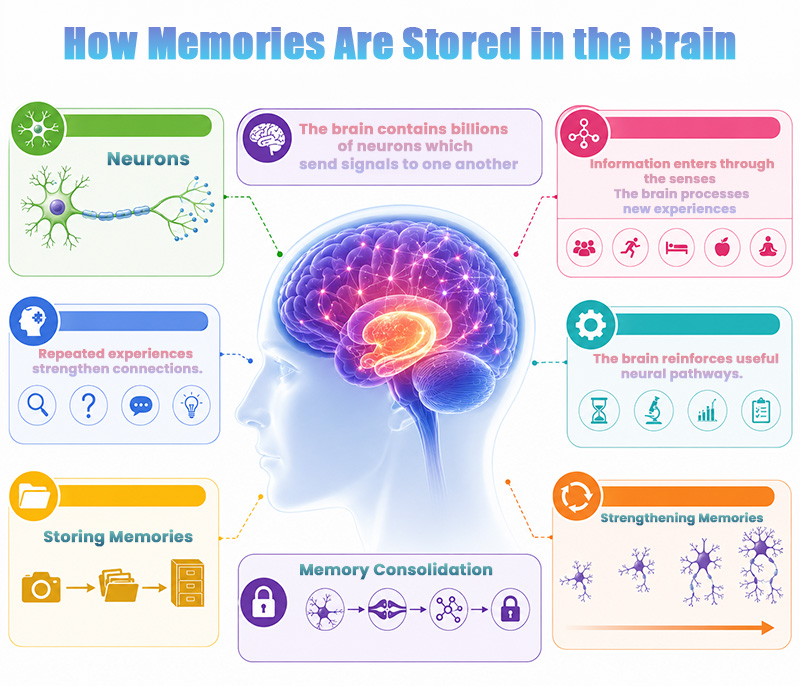
The human brain stores memories through connections between brain cells called neurons. Every time we learn something, our brain makes or strengthens the connections between these neurons. The brain is like a map with lots of roads between cities. The more we use a road, the better it gets. It is the same with our brain. The more we do something. Remember something: the stronger the connection between the neurons becomes. Our memories are not all stored in one place. They are stored in parts of our brain.
For example:
Visual memories are connected to the cortex
Emotional memories are linked with the amygdala
Long-term memories involve the hippocampus
Movement memories involve the cerebellum
So when we remember something, our brain gets information from all these areas at the same time. Scientists think that our brain stores memories through something called plasticity. This means that the connections between the neurons can change and get stronger over time. For example, if you keep practising riding a bicycle, your brain makes those connections stronger.
After a while, riding a bicycle becomes easy. You do not have to think about it. We all know that some memories stay with us forever. Some disappear quickly. This happens because our brain decides which memories are important and should be stored for a time.
Are Memories Stored In Neurons?
One of the most frequently asked questions is, Do neurons store memories?
The answer is yes. Although it is not quite what people expect. Memories cannot be described as being stored in a single neuron, like a file in a drawer, for instance. Rather, they are stored in patterns of connections between numerous neurons. Neurons utilise both electrical and chemical signals to communicate. Chemical signals take the form of tiny packets called synaptic vesicles, which travel across synapses.
When new things are learned, Neurons become even more active. Synapses become even stronger. New pathways for neurons are formed; connections are established for memories. This is called long-term potentiation. To reiterate, the connections become even stronger, and the memories become even more powerful. For example, if a person constantly studies for an exam, that person's brain strengthens the connections for those pieces of information.
Unsurprisingly, scientists have found that memories also have the ability to change, and this happens every single time a person recalls even a portion of that memory. This explains why there are instances in which two people remember the same memory or the same event, but they do so differently.
How Are Memories Stored In The Brain At A Molecular Level?
People often wonder how memories are stored in the brain at a molecular level. If this question appears complicated, the answer is not. Most people, when asking about memory storage at the molecular level, ask about the chemical changes that occur in brain cells. At this level of understanding, memory formation is the result of chemical and physical changes. Neurons, brain cells, release chemicals called neurotransmitters. Certain proteins become activated in the cell. Synaptic connections become stronger, and new linkages between neurons emerge.
How Memories Are Stored And Recalled
Another crucial aspect is how memories are stored and recalled. Memory recall is the process of bringing stored information to the conscious level for use.
For example, you can recall the following: The name of your elementary school, the lyrics to your favourite song, the phone number you want to call. The first step to memory processing is called encoding and occurs when the brain receives stimuli through the senses. Some examples include, but are not limited to, the following:
The face of someone you've met, the narration of a story, the act of reading. After that comes the second step, which is memory storage. In this step, the brain organises the data and decides which information is relevant enough to be stored long-term. Finally, the last step in the memory process is the retrieval of the stored information. This step can either be easy and require no effort or be quite difficult and frustrating, such as in the case when you've temporarily forgotten someone's name, but something later triggers it to be recalled.
Another interesting factor to note is that the retrieval of memories is enhanced when strong emotional ties are present. The most vivid cases of this are often emotionally charged events. Festivals, accidents, and major achievements. The amygdala helps strengthen emotional memories. Sleep is also very important for memory storage and retrieval.
How are Memories Stored in the Brain? Psychology
When discussing “How Are Memories Stored in the Brain?”, psychologists focus on how people learn, store, and recall information. The field of psychology studies how memory affects human behaviour, thinking, and emotions.
Psychologists believe memory is influenced by the following: attention, emotions, repetition, meaning, and experience. For example, we usually remember emotional experiences better than ordinary daily events. One popular psychological theory is called the multi-store model of memory.
Conclusion
Understanding “How Memories are Stored in the Brain” helps us appreciate the incredible power of the human mind. Memory allows us to learn, build relationships, recognise people, and carry experiences throughout life. As we all know, memories shape who we are. From our school days to important life events, memory connects our past to our present.
Scientists continue discovering new information about memory, neurons, and the brain. Research into “How are Memories Stored in the Brain” at a molecular level and into how memories are stored and retrieved may lead to better treatments for memory disorders in the future. If you enjoy learning science and educational topics explained in simple and easy language, explore more helpful learning content at SkillSnap Learning. Here you can find interesting science topics for CBSE classes 6 to 10.