What Is Food Coma? Causes, Duration, And When to Worry

So, "what is food coma?" You know that feeling: you have just eaten, and suddenly your eyes won’t stay open, your brain goes foggy, and your bed feels like the only place in the world that matters. You just finished a big lunch, rice, dal, sabzi, maybe some dessert, and suddenly you can barely keep your eyes open. Sound familiar?
A food coma hits students, adults, and everyone, usually after a large or particularly heavy meal. One minute you are fine, the next you can barely keep your eyes open. But what is a food coma, actually? Why does your body do this? Is it normal, or is something else going on? And should you ever be worried about it? Let us break it all down simply.
What Is Food Coma or Post-Prandial Somnolence?
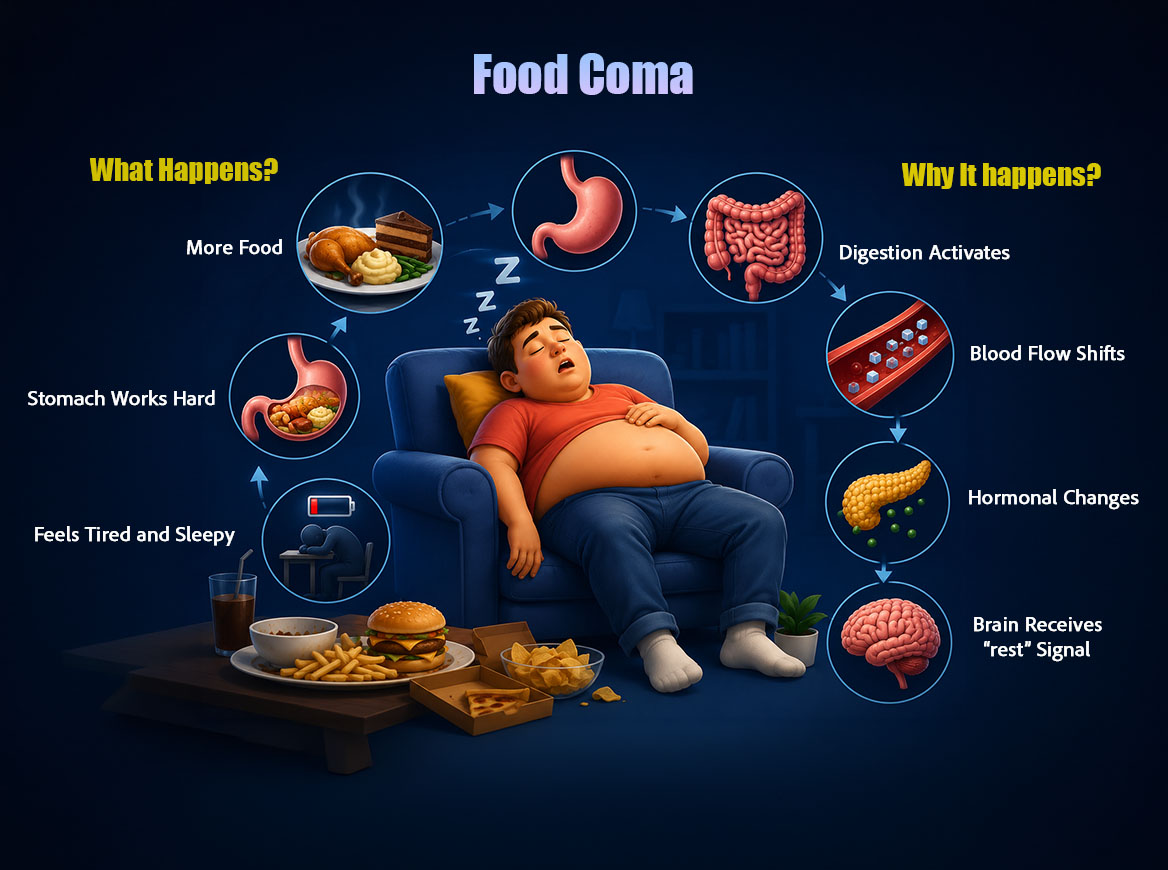
So, "what is food coma?" You eat a big meal, and almost immediately your body just… slows down. That dragging, heavy feeling that follows- that’s what a food coma actually is. You are not actually unconscious; it is more like your body shifts into a lower gear while it focuses on digesting your food.
The scientific term for this is post-prandial somnolence: “post-prandial” meaning “after a meal” and “somnolence” meaning sleepiness. It is a well-documented, completely real physiological response. When you eat, your digestive system gets to work. Your body redirects blood flow toward the stomach and intestines to help break down food. At the same time, hormones like insulin spike, certain brain chemicals shift, and your core body temperature can drop slightly, all of which signal your brain to slow down. The result?
That heavy, almost cosy tiredness most of us know too well.
What Is Food Coma And How Does It Happen?
The causes of food coma are actually pretty interesting from a biology standpoint:
• Blood sugar fluctuations: When you eat foods high in refined carbs or sugar,
blood glucose rises fast and then drops. That “crash” is a big reason you feel tired.
• Hormonal changes: Insulin release after eating triggers the production of tryptophan in the brain, which converts to serotonin and melatonin, both linked to sleep and relaxation.
• Increased blood flow to the gut: Your body prioritises digestion, so less blood (and oxygen) goes to the brain temporarily.
• Overeating: The larger the meal, the harder your digestive system works, and the more pronounced the fatigue.
• High-fat meals: Fatty meals are slower to break down, which means your body stays in digestion mode longer, and the tiredness just sticks around. This is also why post-prandial somnolence tends to be worse after things like a heavy biryani or a festive meal rather than a light salad.
How Long Does a Food Coma Last?
This is one of the most common questions: How long does a food coma last?
For most people, it passes within 30 minutes to 2 hours. A few things decide which end of that range you land on:
How much do you eat
What you eat, a plate of rice hits differently than a bowl of fruits.
How fast or slow your metabolism runs
Whether you were already running low on energy before the meal
Either way, it does not last forever. A short walk, some water, or just giving it time is usually all it takes. It is not dangerous and does not require treatment.
What Is Food Coma, And Is It A Sign of Diabetes?
Here is where it gets a little more serious. Is a food coma a sign of diabetes? For most healthy people, occasional post-meal sleepiness is perfectly normal. But if you are feeling extremely tired after every single meal, especially after modest portions, it could be worth paying attention. In people with diabetes or pre-diabetes, blood sugar regulation does not work as smoothly. After eating, glucose can spike much higher than normal and then drop sharply, causing more intense fatigue than usual. So, while a food coma on its own does not confirm diabetes, whether a food coma is a sign of diabetes is a fair question if it is happening very frequently and is accompanied by symptoms like excessive thirst, frequent urination, or blurred vision. If that is the case, it is always best to speak to a doctor.
Tips to Avoid the Post-Meal Slump
If you want to stay sharp after lunch, especially on a school day, here are some practical things that actually help:
• Eat smaller portions and don’t skip breakfast
• Avoid refined carbs and sugary drinks with meals
• Go for a short walk after eating, even 10 minutes makes a difference
• Stay hydrated throughout the day
• Do not eat while lying down or right before sitting for long stretches
Conclusion
So, what is a food coma in simple terms? It is your body’s natural response to digestion, a temporary dip in energy and alertness after eating. Medically known as Post-Prandial Somnolence, it is normal, common, and usually harmless. How long a food coma lasts depends on your meal and metabolism, but it typically passes within an hour or two. Just be mindful: if it is happening consistently and severely, it is worth asking a doctor.
Think food coma is interesting? There’s a lot more to learn. SkillSnap Learning offers dedicated courses for classes 6-10. Use our free study material and go through our NCERT Solutions today.