What is Placebo Effect? Meaning, Definition, And Examples

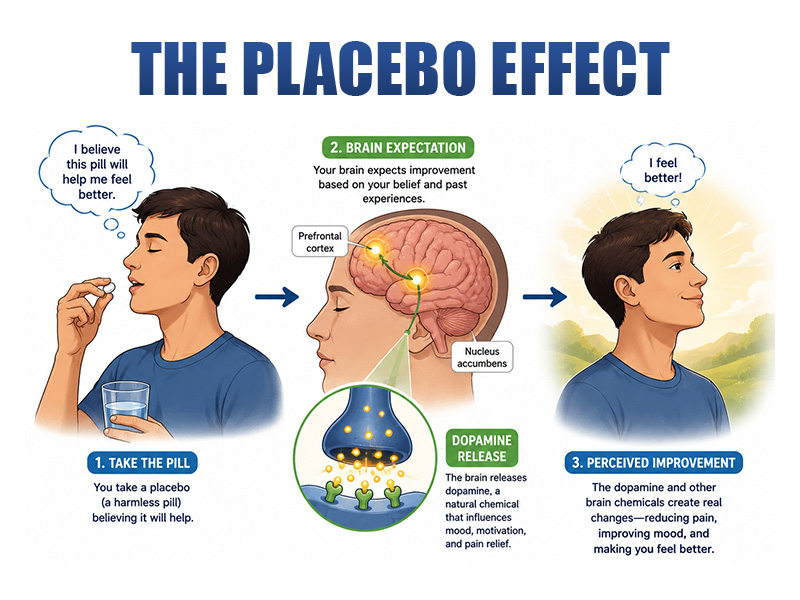
If you have ever asked, “What is placebo effect?”, here is the easy version: you take a sugar pill, you are told it is a medicine, and somehow you actually start to feel better. No active ingredient. No real drug, Nothing. Just the belief that you are being treated, and somehow that is enough.
It sounds like a trick. But it isn’t. The improvement is measurable. It shows up in brain scans, blood tests, and real symptoms getting better. It happens in hospitals, in clinical trials, in everyday life. And it has been confusing scientists for decades. This is the basic breakdown of what is actually happening.
What Is Placebo Effect In Psychology?
In psychology, the placebo effect comes down to one word: expectation. The brain is constantly predicting outcomes. When you believe a treatment will help, your body starts preparing for that result: releasing endorphins, lowering stress hormones, and shifting how you process pain. Psychologists call this the expectancy effect. The mind doesn’t just observe what's happening to the body. It actively shapes it.
This is why the bond between a patient and their doctor matters so much. A confident, warm doctor reliably produces stronger placebo responses than a cold or distant one. The context of healing is part of the treatment.
Examples Of The Placebo Effect
These aren’t theories. These are documented cases where fake treatments produced genuine, measurable results. Here are some placebo examples:
Fake Knee Surgery: Patients who received sham surgery, like just incisions and no actual procedure, reported the same level of pain relief as those who had the real operation. Their knees genuinely felt better.
Parkinson’s Disease: Patients given a placebo injection showed real increases in dopamine, the exact chemical that the disease gradually destroys. Their tremors reduced. No drugs involved.
IBS Treatment: In a Harvard study, patients with irritable bowel syndrome were given placebo pills and told upfront they were fake. Over half reported significant improvement in symptoms.
Saline injections for pain: Patients told that a saline drip was a powerful painkiller reported genuine reductions in post-surgical pain, the same kind seen with real analgesics.
What Is Placebo Effect, And Is It Real?
Yes, completely. One of the biggest myths about the placebo effect is that the person is just imagining improvement. They are not. Patients with Parkinson’s disease given fake medication have shown an actual increase in dopamine- the same chemical the disease depletes. Pain genuinely reduces. Inflammation shows measurable drops. These are not reported feelings. These are physical changes in the body confirmed in labs.
What Affects How Strong It Is
Not every placebo works the same way. These factors considerably shift the strength of the
Response.
Bigger, more expensive-looking pills trigger a stronger response than small, plain ones.
Injections produce a stronger effect than pills — they feel more medically
significant.
Pill colour matters: warm colours feel stimulating, cool colours feel calming.
A warm, confident doctor consistently produces a stronger placebo response than
a distant one.
Conclusion
So, what is the placebo effect? It is documented proof that the mind and body are far more
connected than most people realise. A treatment with no active ingredient can produce
real, measurable biological changes — because the brain, given the right context and
expectation, will act as if it has received medicine. It is not about being gullible. It is about how deeply belief is wired into our mind and biology.
Want to keep learning? SkillSnap Learning offers in-depth courses for classes 6-10 with dedicated 24/7 support. Explore our free study resources and Worksheets today.