5G vs 6G: Speed, Range, Difference, and Future Technology
The debate between 5G and 6G is becoming more prominent as communication technology continues to evolve. Change is a constant in technology, and mobile internet is no different. Just a few years back, mobile users were dependent on 3G and 4G networks. 5G networks are replacing those generations. Simultaneously, networks are being developed and tested in anticipation of 6G. The blog includes heterogeneity of 5G and 6G, the difference in their distance and speed capabilities, and, overall, the communication network of the future.
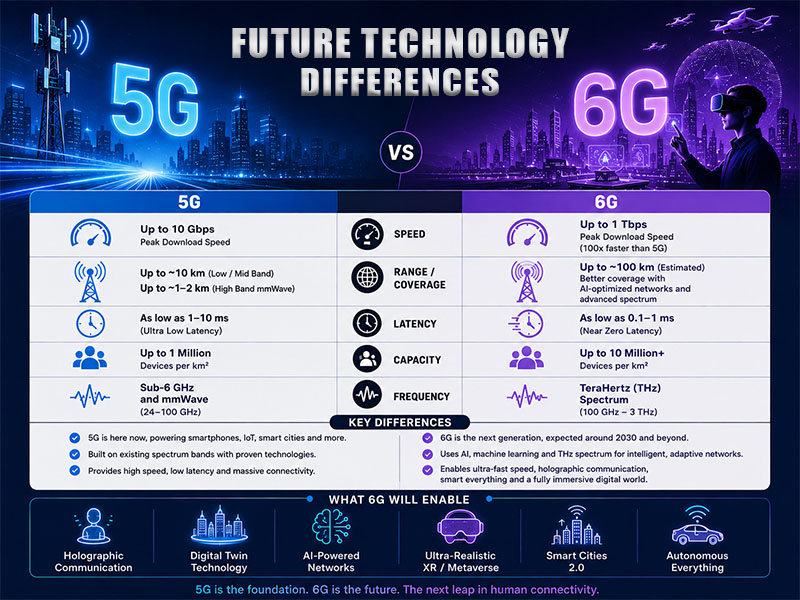
What Is 5G and 6G Technology?
Many technology enthusiasts are interested in understanding the differences between 5G VS 6G.5G is the next generation of mobile technology and comes with enhancements of speed, latency and connection over 4G. The advantages of 5G are seen in the areas of video streaming, gaming, downloads and more. 6G, the generation of mobile technology after 5G, is predicted to be commercially available after the year 2030 and is currently a concept. 6G is forecasted to be exponentially faster and smarter than 5G. Some initiatives of 6G are predicted to be the embedding of AI, smart cities and holographic communication.
5G vs 6G Speed
Speed is one of the biggest difference factor between 5G and 6G. The max 5G speeds vs previous mobile networks are more than an order of magnitude greater. Due to these speeds, users can download large files, high-quality videos, and experience almost imperceptible lag in video games. Comparatively, 6G is theorised to be multiple times more rapid than 5G networks. Taking that into consideration, computing speeds of 1 Tbps would be an almost 100 times speed increase from the current 5G technologies. Such speeds would break even more digital computing barriers. Such speeds would even improve the technology of perception-based interfaces and smart devices. You may perceive an almost instantaneous response.
5G vs 6G Range
Experts often discuss 5G VS 6G when talking about faster internet speeds and better range. 5G works great in urban areas, as the technology was built around delivering high speeds to high population concentrations. 5G ranges do have limitations, and physical barriers and environmental conditions affect the overall quality. 6G is expected to take further advantage of even more advanced technology. Coverage will most likely improve even with the high frequencies. Maintaining even higher frequencies could be even more of a challenge. Technologies of the future are being worked on, such as smart antennas and satellite connections.
5G vs 6G Frequency Bands
The first thing to consider is their frequency bands when comparing 5G and 6G
5G utilises three key frequency types:
Low-bands with long range
Mid-bands with speed and range balance
High-bands with the fastest 5G internet
These bands allowed 5G to outperform pre-existing networks. 6G will utilise bands in the terahertz range, which are significantly beyond the 5G range. Using higher frequencies means 6G is able to transmit data at speeds never before seen, and thus may enable technology like intelligent robots, connected cars, and real-time holographic conversations.
Conclusion
When comparing 5G and 6G, the exponential growth of wireless technology in recent years becomes apparent. 5G has improved global mobile internet, communication, and device connectivity, while the anticipated benefits of 6G will include ultrafast mobile connectivity, intelligent AIs, and novel communication techniques. In the 5G vs 6G speed comparison, 6G will be faster. From the 5G vs 6G frequency and range comparison, while 6G will exhibit improved connectivity, 5G will present the infrastructure necessary to support it.
If you want to learn more about modern technology, networking, and future digital trends, join SkillSnap Learning and improve your knowledge with easy-to-understand courses and practical learning resources.