Why do dams have thick walls at the bottom ?
Why do dams have thick walls at the bottom | Easy Explanation
Have you ever wondered why dams are much thicker at the bottom than at the top?
The answer lies in an important scientific concept called water pressure. Water exerts pressure on everything around it, and this pressure increases as the depth of water increases. Because the lower part of a dam experiences much greater pressure than the upper part, engineers design dams with thicker walls at the base. In this article, we will understand how water pressure works and why dams need strong, thick foundations to withstand the force of water.
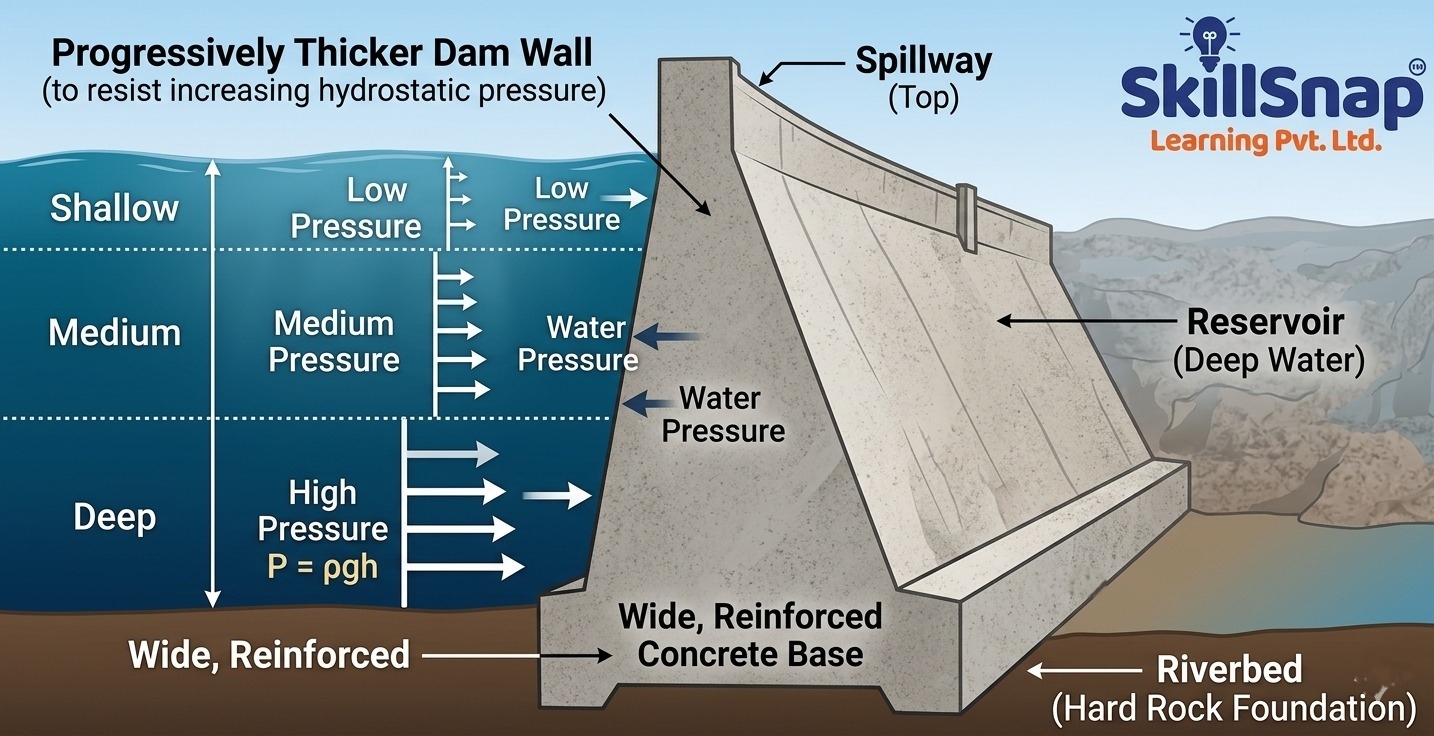
How Does Water Pressure Work?
Water pressure is the force exerted by water on the walls and bottom of a container or any object placed in water. Water pressure increases with depth because the weight of the water above increases as we go deeper.
The pressure exerted by water is given by:
P = h\rho g
Where:
P = pressure
h = depth of water
ρ (rho) = density of water
g = acceleration due to gravity
This formula shows that deeper water creates greater pressure. That is why swimmers feel more pressure in their ears when they dive deeper into a swimming pool.
Why do dams have thick walls at the bottom (short)
The reason why dams are built to have thicker structures in the bottom part is because there is a lot of pressure at the bottom due to the presence of water. The bottom water experiences greater pressure than the top water.
Pressure depends on the depth of water:
P = hρg
The deeper the depth, the greater the pressure exerted. Therefore, the bottom part of the dam has to endure this great pressure.
Why do dams have thick walls at the bottom (long)
The reason why dams are built with a thick wall at the base is due to the increased water pressure that results from an increase in depth. Water pressure rises proportionately to depth; thus, the base of the dam being submerged at a greater depth is subjected to higher pressures.
Pressure caused by a liquid is expressed as:
P=hρgP = h\rho gP=hρg
where:
PPP = pressure
hhh = height of liquid
ρ\rhoρ = density of water
ggg = acceleration due to gravity
As illustrated by the above formula, water pressure increases as the depth of the water increases. At the top of the dam, the pressure is relatively low, hence making it easier to construct thin walls. However, deep down in the dam where the pressure is higher, the walls have to be thicker.
Why Are Dam Walls Thick at the Base?
Dams are constructed with thick walls at the bottom to:
Resist high water pressure
Maintain stability
Prevent cracks and collapse
Support the enormous weight of stored water
Increase the strength and durability of the structure
Example from Real Life
Bhakra Dam has a wider and stronger base due to the high water pressure experienced by the lower side of the dam.
Fun Fact
Do you know that the pressure exerted by water at the bottom of a deep dam is much higher than the pressure near the top?
Conclusion
In short, the reason why a dam has a thick wall at the base is due to the fact that pressure of water is highest at deeper levels.