What Is Habitat Class 6: Definition, Types, and Key Concepts
What Is Habitat Class 6: Definition, Types, and Key Concepts
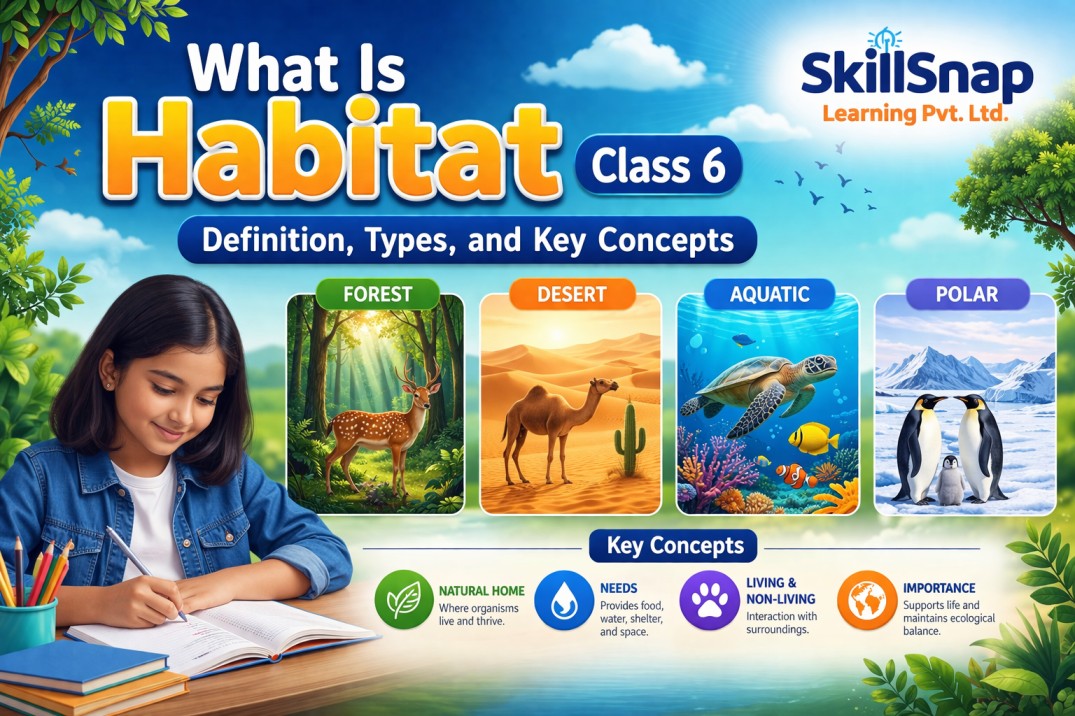
Think about where a fish lives? In Water…
Where does a camel live? A desert…
Where does a monkey live? A forest…
Every living being has a specific place where it lives, finds food, and survives. That place is called its habitat. In CBSE Class 6 Science, the chapter "The Living Organisms: Characteristics and Habitats" introduces this important concept. In this blog, we explain what is habitat, types of habitats, Habitat and Adaptation, define habitat, and provide important exam questions and answers.
What Is Habitat?
A habitat is the natural place where an organism lives. It provides everything an organism needs to survive: food, water, air, shelter, and space for breeding. The word habitat comes from the Latin word meaning dwelling place.
Components of a Habitat: Biotic and Abiotic
The place where an animal or plant lives is called its habitat. In short, Habitat means a dwelling place which provides shelter, air, water, and food to plants or animals. Every habitat has two types of components:
Biotic Components (Living Things)
These are all the living organisms present in a habitat: plants, animals, fungi, and microorganisms. For example, in a pond habitat, fish, frogs, lotus plants, and algae are biotic components.
Abiotic Components (Non-Living Things)
These are the non-living parts of the habitat that support life. They include soil, water, air, sunlight, temperature, and rocks.
Remember: Soil, water, and air are the abiotic factors of a habitat.
Types of Habitat
The surroundings where living organisms survive are called a habitat. Different types of organisms are found in different regions of the world. Habitats are mainly of two types:
Terrestrial Habitat (Land-Based)
Habitats found on land are called terrestrial habitats. These include:
Forests: home to tigers, elephants, deer, and many trees.
Deserts: home to camels, cactus, and desert rats.
Mountains: home to snow leopards, oaks, pines, and deodar trees.
Grasslands: home to lions, deer, and grass plants.
Aquatic Habitat (Water-Based)
Habitats found in water are called aquatic habitats. These include:
Freshwater habitats: ponds, rivers, and lakes (home to fish, frogs, hydrilla, lotus)
Marine habitats: oceans and seas (home to dolphins, whales, sharks, and sea plants)
Some organisms primarily live in the air or spend most of their time flying. Birds like eagles and sparrows, and insects like mosquitoes, live in aerial habitats.
What Is Adaptation?
Every organism has special features that help it survive in its particular habitat. These special features are called adaptations.
Definition of Adaptation: The presence of specific features that enable a plant or animal to live in a particular habitat is called adaptation. Here are some examples:
Desert Adaptation (Cactus)
Leaves are modified into spines to reduce water loss (transpiration).
The stem is thick and green and carries out photosynthesis.
Roots go very deep into the soil to absorb water.
Desert Adaptation (Camel)
Stores fat (not water) in its hump.
Can go for long periods without water.
Has long legs to keep its body away from the hot desert sand.
Aquatic Adaptation (Fish)
Has a streamlined body to move easily through water.
Has gills to breathe underwater.
Has fins and a tail for swimming.
Mountain Adaptation (Pine, Deodar)
Have conical shape so snow slides off without breaking branches.
Have needle-like leaves to reduce water loss in cold conditions.
What Is Habitat Class 6: Important Questions & Answers
Q1. What is a habitat? (Short Answer)
Answer: A habitat is the place where organisms live. It provides the organisms with food, water, air, shelter, and other survival needs. Habitat means a dwelling place.
Q2. What are the types of habitat?
Answer: There are three main types of habitat:
Terrestrial habitat: land-based habitats like forests, deserts, mountains, and grasslands.
Aquatic habitat: water-based habitats like ponds, rivers, and oceans.
Aerial habitat: for organisms that live in the air, like birds.
Q3. What are biotic and abiotic components of a habitat?
Answer: Biotic components are living things in a habitat, such as plants and animals. Abiotic components are non-living things in a habitat, such as soil, water, air, sunlight, and rocks.
Q4. What is adaptation?
Answer: Adaptation is the presence of specific features that enable a plant or an animal to live successfully in a particular habitat. For example, a camel is adapted to live in a desert, and a fish is adapted to live in water.
Q5. Why is speed important for animals in grassland habitats?
Answer: In grasslands, there are very few trees or places for animals to hide. Predators like lions and tigers can easily spot their prey. To escape from predators, grassland animals like deer need to run very fast. Hence, speed is an important adaptation for survival in grassland habitats.
Q6. Name two organisms found in desert habitats.
Answer: Cactus (plant) and Camel (animal) are two organisms found in desert habitats.
What Is Habitat Class 6: Key Points to Remember
Habitat is the place where organisms live and get food, water, air, and shelter.
The two components of a habitat are biotic (living) and abiotic (non-living).
The three types of habitat are terrestrial, aquatic, and aerial.
Adaptation is the special feature that helps an organism survive in its habitat.
Cacti and camels are adapted to the desert. Fish are adapted to water. Pine trees are adapted to the mountains.
Soil, water, and air are the abiotic factors of a habitat.
Study Smarter with Our Online Course for Class 6
Concepts like what is habitat class 6 and adaptation are the building blocks of science. Once you understand them well in Class 6, higher classes become much easier. Our online courses for Classes 6 to 10 are designed to help every student understand CBSE topics deeply, with live classes, easy notes, practice questions, and expert teachers.
Subject-wise live classes for the CBSE board.
Chapter-wise notes and short-answer guides.
Regular tests and doubt-clearing sessions.
Enrol today with SkillSnap Learning and start this academic session on the right note!