What Is Diversity Class 6: Social Science Question & Answers
What Is Diversity Class 6: Social Science Question & Answers
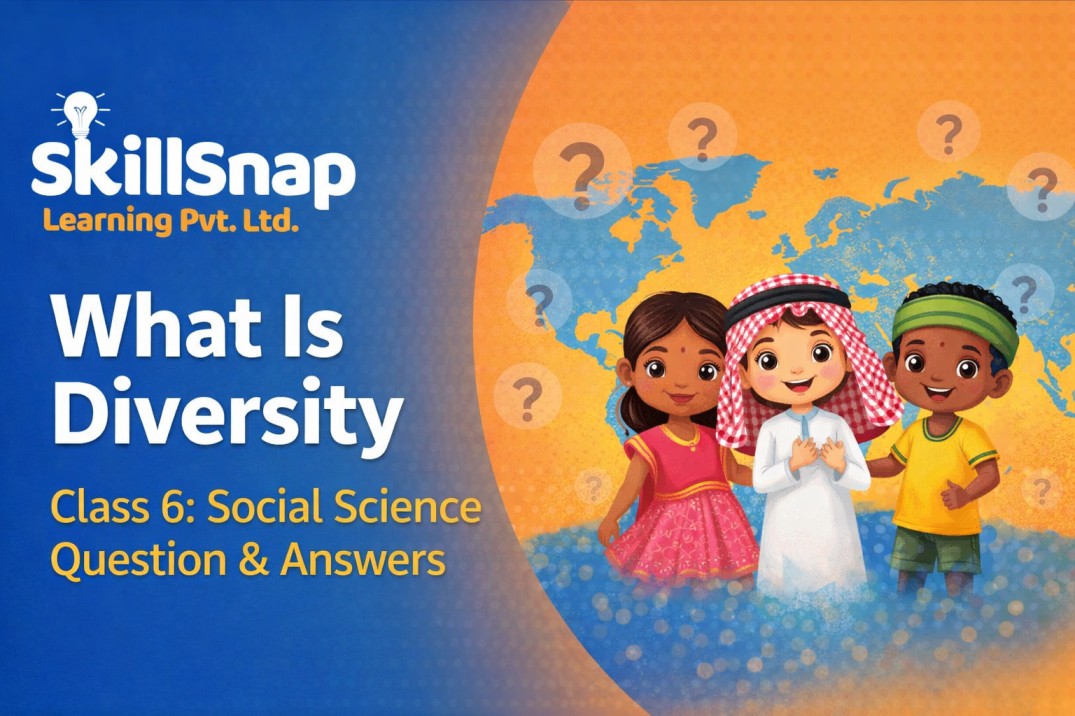
Do you know that your fellow classmates vary from each other? They may be speaking a different language, eating different cuisines, celebrating different festivals, or practising different religions. This is referred to as diversity.
The topic of diversity is mentioned first in CBSE Class 6 Social Science (Civics) Chapter 8, and is one of the key topics of this chapter, as it explains how to respect others who belong to different societies.
Through this blog, we are going to elaborate on what is diversity Class 6, its meaning, types of diversity in India, the concept of unity in diversity, and related concepts.
What is Diversity Class 6: Related Questions & Answers
Here are the most important questions and answers from Chapter 8 for your exam preparation:
Q1. What do you mean by diversity for Class 6? / Define diversity Class 6.
Answer: Diversity means that each individual is unique and different from others. These differences may be in terms of personal qualities, physical features, language, religion, culture, social background, or economic status. India is a country of vast diversity where people of many different backgrounds live together.
Q2. What is diversity? (Short Answer)
Answer: Diversity means differences among people in terms of language, religion, culture, traditions, and way of life. It means recognising that every person is unique.
Q3. What do you understand by diversity?
Answer: Diversity means the variety of differences found among people and communities. When we understand diversity, we learn to appreciate the uniqueness of every individual and every culture. It teaches us to respect people who look, speak, or live differently from us.
Q4. What does diversity add to our lives?
Answer: Diversity adds richness and variety to our lives. We learn different languages from our friends. We enjoy different kinds of food, music, and dance. We celebrate festivals of different communities. We learn from different cultural traditions and ways of life. This makes our lives more interesting and complete.
Q5. Do you think the term "unity in diversity" is an appropriate term to describe India?
Answer: Yes, "unity in diversity" is a very appropriate term to describe India. India is home to people of many different religions, languages, and cultures. Yet, as a nation, they are united. During the freedom struggle, people from all regions and communities fought together against British rule. Today, they share their festivals on a national level and stand together during any calamity or crisis. Thus, it proves that irrespective of all differences, India is one single nation.
Q6. What are the factors that influence diversity in India?
Answer: Two main factors influence diversity in India:
Geographical factors: Diverse landscapes, weather conditions, and natural resources result in diverse lifestyles.
Historical factors: Hundreds of years of interaction between civilisations through trade and invasion have contributed to diversity in India.
Q7. Give one example to show why diversity is important in our lives.
Answer: Without diversity in language and culture, writers and artists will have no inspiration to create literary pieces. Literature and culture gain value from the differences in languages, tales, songs, and arts from various groups of people. Therefore, diversity is significant.
Q8. How are Kerala and Ladakh different from each other? (Diversity in India Class 6)
Answer:
Kerala is a coastal state with a tropical climate. Ladakh is a cold desert in the Himalayas.
Kerala is known for growing spices. Ladakh is known for growing wool.
Keralites eat rice and fish. People in Ladakh eat food suited to their cold climate.
Kerala has a rich maritime and spice trade history. Ladakh has a history connected to Tibet and Buddhism.
Q9. How are Kerala and Ladakh similar to each other?
Answer: Despite being geographically very different, both Kerala and Ladakh share some similarities. Both were visited by traders from the Arab world and China, and their cultures were affected. In both countries, there is peaceful coexistence among people of various religions. Both have festivals and customs associated with their rich cultural background.
Extra Question & Answer for What is Diversity Class 6
Despite all these differences, the people of India are united. They stood together against British rule during the freedom struggle. They celebrate national festivals like Independence Day and Republic Day together. They sing the national anthem with equal pride.
Q1. What is linguistic diversity in India?
Answer: Linguistic diversity means the variety of languages spoken in India. India has 22 officially recognised languages and over 1,600 languages spoken as mother tongues. Hindi and English are the official languages of the Union government. This makes India one of the most linguistically diverse countries in the world.
Q2. How did the freedom struggle unite India's diversity?
Answer: In the struggle for independence in India against the rule of the Britishers, people from all quarters joined hands for the cause of freedom. The Indian national flag symbolised unity among people in the struggle. It is said that a song that was sung following the Jallianwala Bagh tragedy had this line, "The blood of Hindus and Muslims flows together today."
Q3. What is Ladakh known as and why?
Answer: Ladakh is called ‘Little Tibet’ due to its similarities in culture, religion, and geography with Tibet. Buddhism is a popular religion in Tibet and also in Ladakh. Geographically, the mountainous and cold desert-like terrain of Ladakh is quite similar to that of Tibet.
What Is Diversity Class 6: Definition and Meaning
Diversity definition: Diversity means the existence of differences among people. These differences can be in terms of language, religion, food, culture, festivals, clothing, and way of life. In simple words, when we say someone or something is diverse, we mean it is made up of many different types of people or things.
Diversity means that each individual is unique. It refers to the differences among people in terms of race, language, culture, religion, region, and socio-economic background. Look around your classroom. No two students are exactly alike. This uniqueness, this difference, is what we call diversity.
Want to Learn More? Join Our Online Classes for Class 6
Understanding chapters like diversity is just the beginning. Our online courses for classes 6 to 10 are designed to help students master every CBSE subject with easy explanations, live classes, and expert teachers, just like this blog, but even better. Start your learning journey today! Enrol now and give your child the best start to the new academic year with SkillSnap Learning.
Live interactive doubt-solving session for all CBSE subjects.
Easy notes and short-answer guides for every chapter.
Regular practice tests and Q&A sessions.
Doubt-clearing support from experienced teachers.