What Is a Simple Pendulum: Class 7 Science Explained
What Is a Simple Pendulum: Class 7 Science Explained
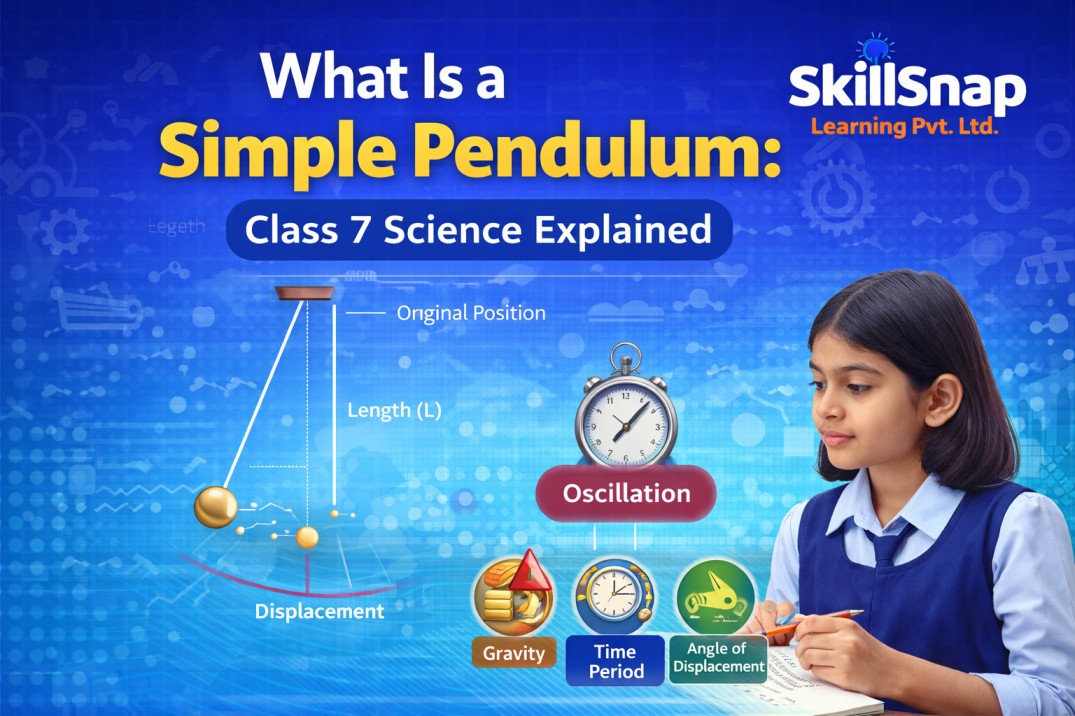
Imagine you have a piece of string, you tie a small, heavy object (like a metal ball or even a large marble) to the end of it, and hang it from a fixed point so it can swing back and forth. That is a simple pendulum. In science, we call the heavy object at the bottom a bob. Go through the complete blog to learn What Is Simple Pendulum Class 7.
What Is Simple Pendulum? (Class 7 Definition)
A simple pendulum consists of a small metal ball (called a bob) suspended by a long thread from a rigid support, such that the bob is free to swing back and forth. In short, it is a weight hanging from a fixed point on a string that swings freely. That's it.
This topic comes from Chapter 13: Motion and Time in the NCERT Class 7 Science textbook.
Parts of a Simple Pendulum
A simple pendulum has just three parts:
Bob: The small metal ball (or weight) at the bottom. It is the swinging part of the pendulum.
Thread (String): The string that connects the bob to the support. The length is measured from the point of suspension down to the centre of the bob.
Rigid Support: The fixed point from which the thread is hung. It does not move.
How Does a Simple Pendulum Work?
When the bob is at rest, it hangs straight down. This resting position is called the mean position. If the bob is pulled to one side and then released, it will begin to oscillate to-and-fro (back and forth) like a swing. The bob moves from position B to position C and keeps repeating this back-and-forth motion between the two extreme positions. This back-and-forth motion is called oscillatory motion or periodic motion.
Important Terms You Must Know
Oscillation: When the bob of a simple pendulum moves from its mean position B to A and back to B again, then from B to C and back to B again, the pendulum is said to complete 1 oscillation.
Time Period: The time taken by the pendulum bob to complete one oscillation is called its time period.
Amplitude: The maximum displacement of the bob from its mean position on either side is called the amplitude of the pendulum.
Length of Pendulum: The length of the thread from the point of suspension to the centre of the bob.
Who Discovered Simple Pendulum?
The motion of the pendulum was first studied by Galileo. Galileo discovered the important principle of the pendulum: a pendulum completes every swing in the same time, provided its length is kept constant. This means that a longer pendulum swings more slowly, and a shorter one swings faster. As the length of a pendulum is increased, its time period also increases.
How to Calculate Time Period (Formula for Exam)
This is the most commonly asked numerical in Class 7 exams. You can calculate the time period using the formula mentioned below:
Time Period = Total Time Taken ÷ Number of Oscillations
Example: A simple pendulum takes 32 seconds to complete 20 oscillations. What is the time period?
Ans: Total Time Taken = 32 seconds
Number of Oscillations = 20
Time Period = Total Time Taken ÷ Number of Oscillations
Time Period = 32 ÷ 20 = 1.6 seconds.
Real-Life Example: The Pendulum Clock
The periodic motion of a pendulum is utilised in pendulum clocks for measuring time. The pendulum of a pendulum clock is a long metal rod having a heavy metal bob at its lower end. When the pendulum swings continuously, its upper end drives some toothed wheels, which then turn the hours, minutes, and second hand on the dial of the clock.
Quick Revision Points for What Is Simple Pendulum Class 7
A simple pendulum = bob + thread + rigid support.
The to-and-fro motion of a pendulum is called oscillatory or periodic motion.
One complete back-and-forth movement = 1 oscillation.
Time for one oscillation = Time Period.
The time period depends on the length of the pendulum, not the weight of the bob.
A longer pendulum leads to a longer time period.
Galileo first studied pendulum motion.
Formula: Time Period = Total Time ÷ Number of Oscillations.