Dark Adaptation: Meaning, Mechanism, Time & Eye Adjustment
Dark Adaptation is an example of how our eyes adjust to the transition between being exposed to high levels of light and being in conditions where there is low visibility around us. For instance, if you step inside a dark room from outside where there is a lot of light, your ability to see will be temporarily impaired until your eyes begin to work effectively. This process is termed Dark Adaptation.
The human eye is constantly adapting to changes in the environment, whether that means going to the movies or driving at night with dimmed lights.
What is Dark Adaptation?
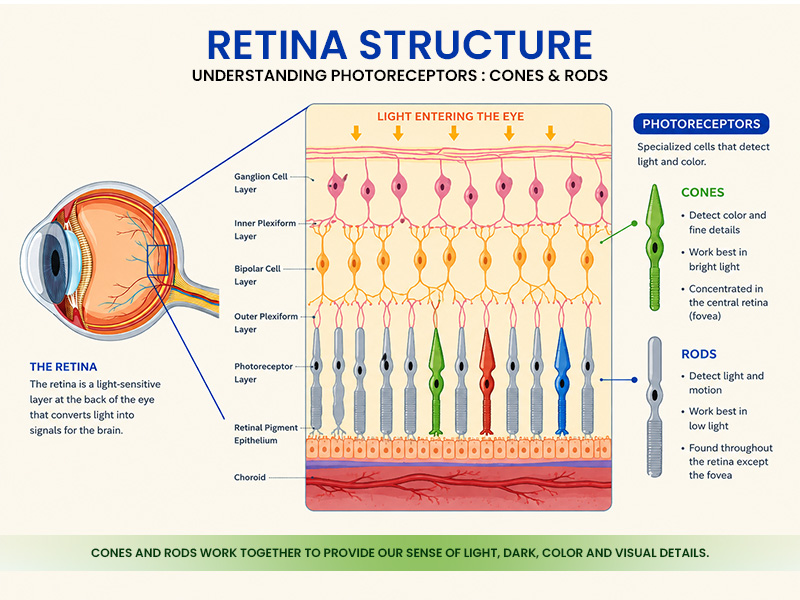
Dark adaptation refers to the process through which your eyes become more sensitive in dim light or dark surroundings after exposure to bright sunlight. The retina contains two types of photoreceptor cells:
Cones: responsible for colour vision and bright-light vision.
Rods: responsible for night vision and low-light sensitivity
In short, when your eyes come into contact with bright light, the cone cells remain active. However, in darkness, rod cells gradually become more effective and improve visibility.
Dark Adaptation of Eyes
The dark adaptation of the eye is extremely important for us and our eyes for proper night vision. Especially when a person enters a dark room, their visibility becomes limited because when a person suddenly comes from bright light to dark light, their eyes can not adjust to the change immediately because their visibility is limited. Over time, slowly, your eyes get comfortable and adjust to seeing in the dark and begin detecting objects more clearly. This process involves:
Expansion of pupils.
Increased sensitivity of rod cells.
Regeneration of visual pigments.
Better ability to detect dim light.
Note: Without dark adaptation, seeing clearly at night would become difficult.
Dark Adaptation Mechanism
The dark adaptation mechanism mainly depends on a visual pigment called Rhodopsin, which is found in rod cells. The process works in the following way:
Bright light breaks down rhodopsin.
In darkness, rhodopsin starts regenerating.
Rod cells become more sensitive to light.
Vision improves in dark surroundings.
Dark Adaptation Time
This is actually one of the most common questions people ask about dark adaptation time. Generally:
Initial adjustment occurs within 5 to 10 minutes.
Complete dark adaptation may take 20 to 30 minutes.
Sometimes, the exact duration depends on various factors:
Age
Eye health
Intensity of previous light exposure
Overall retina condition
Note: Younger people usually adapt faster than older adults.
Dark Adaptation Examples
A common dark adaptation example is something which we can experience in everyday life. When we use our phone in the daytime, our phone brightness is at full, so we can see our phone screen clearly in sunlight. However, when we are outside and use our phone at night in full brightness, our surroundings appear darker. It happens only because we can not see properly in the brightness of the phone in a dark room, but once we dim the brightness and close our eyes for a few minutes, we can see everything, because it takes time to adjust our eyes to that surrounding.
Dark Adaptation Test
A dark adaptation test is a type of test which measures how effectively the eyes adjust to darkness. Doctors may recommend this test to diagnose.
Night blindness
Retinal disorders
Vitamin A deficiency
Problems related to rod cells
At the time of the test, the eyes are exposed to bright light first. Afterwards, Specialists measure how quickly our vision improves in dim conditions.
What is dark adaptation in Psychology?
In psychology, dark adaptation refers to the adjustment of the visual and sensory system when moving from bright surroundings to low-light conditions. This is how psychologists study dark adaptation in our understanding:
Sensory perception.
Human visual processing.
Environmental response.
Attention and reaction mechanisms.
And this is the most important topic in sensory psychology.
Importance of dark adaptation
Dark adaptation plays a vital role in our daily activities and professional environments. It is important for:
Safe night driving.
Aviation and military operations.
Emergencies.
Astronomy observation.
Movement in dark environments.
Tips to Improve Dark Adaptation
We can support healthy night vision and better dark adaptation through simple habits:
Reduce bright screen exposure before sleep.
We have to eat vitamin A-rich foods such as carrots and spinach.
Wear anti-glare glasses while driving at night.
Allow your eyes enough time to adjust naturally.
Maintain regular eye examinations.
Important tip: Our healthy eye care routine can improve our vision efficiency.
Conclusion
Dark Adaptation is a biological and vital phenomenon in which our eyes adjust from bright light environments to darkness. This is a very important process in which we can improve our visibility, increase our night vision, and move around safely under dark conditions. The study of dark adaptation technique, duration, and examples makes it easier for us to understand the effectiveness of our eyes in adjusting to the changes in the environment. Dark adaptation may be discussed in psychology, ophthalmology, or even in everyday life.