Chandrayaan 3 Mission: Key Facts, Dates, and Achievements
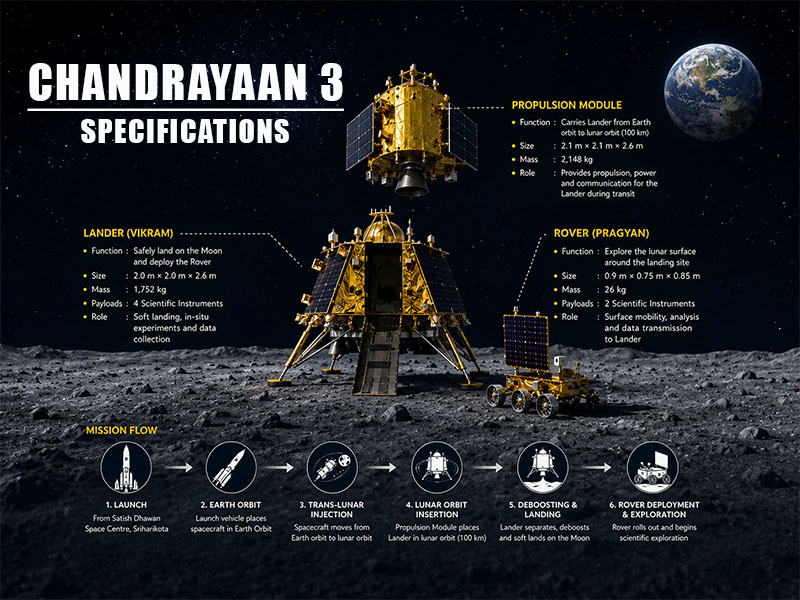
With the Chandrayaan-3 Mission, ISRO is taking preparatory steps for more ambitious future endeavours in space by developing technology to execute a soft landing on the Moon and deploy its first-ever lunar rover. The Chandrayaan-3 launch date was July 14, 2023. This goal was achieved on August 23, 2023, when the Chandrayaan-3 mission successfully performed a soft landing in the first-ever uncharted South Polar Region of the Moon.
This achievement also made India the fourth country to successfully land on the moon, as it was the first landing in that region. The mission of Chandrayaan-3 comprised three major parts: the Vikram Lander, the Pragyan Rover and a Propulsion Module.
Overview of Chandrayaan 3 Mission
Developed by the Indian Space Research Organisation, India's third moon mission, Chandrayaan-3, was launched by an LVM3 rocket from the Satish Dhawan Space Centre. The Chandrayaan-3 mission intended to land on the lunar surface and place an exploratory rover. India became one of the few countries to land on the moon, but the first to complete a moon landing in this specific region. The Pragyan Rover was the first Indian rover to conduct exploratory rover activities on the Moon. It included the assessments of soil and rocks, as well as measuring the temperature and the chemical makeup of the lunar surface.
Chandrayaan 3 Mission Details
The Pragyan Rover, once landed, travelled the Moon’s surface to perform analyses. Measurements of the soil and rock, as well as record-keeping of the temperature and composition, were all performed to enrich the understanding of the Moon’s environment. This project further helped in the development of crucial technology used for landing, navigation, and movement of a lunar rover.
Parameter | Specification | |
1 | Mission Life (Lander & Rover) | One lunar day (~14 Earth days) |
2 | Two Module Configuration |
|
3 | Communication |
|
4 | Lander Mechanisms |
|
5 | Lander Touchdown specifications |
|
6 | Science Payloads | Lander:
|
7 | Power generation |
|
8 | Lander Sensors |
|
9 | Lander Propulsion System | Bi-Propellant Propulsion System (MMH + MON3), 4 nos. of 800 N Throttleable engines & 8 nos. of 58 N; Throttleable Engine Control Electronics |
10 | Mass |
|
11 | Landing Site (Prime) | 4 km x 2.4 km 69.367621 S, 32.348126 E |
Chandrayaan 3 Vs Chandrayaan 2
Chandrayaan-3 and Chandrayaan-2 are lunar missions developed by the Indian Space Research Organisation (ISRO). While Chandrayaan-2's lander could not achieve a successful landing, the Chandrayaan-3 Mission successfully soft-landed on the Moon. The difference between the two missions is shown in the table below:
Feature | Chandryaan-2 | Chandryaan-3 |
Launch | 22 July 2019 | 14 July 2023 |
Landing site | Near the Moon's south polar region (planned) | Near the Moon's south polar region |
Main target | Lunar mapping, mineral analysis, and landing attempt | Reliable landing technology and surface exploration |
Safety features | Limited landing redundancy | Improved sensors, stronger landing legs, and enhanced safety systems |
Rover | Pragyan Rover | Pragyan Rover |
lander | Vikram Lander | Upgrade Vikram Lander |
Mission success | Partial success (orbiter successful, lander unsuccessful) | Complete success with soft landing and rover operation |
Orbiter | Yes, included a dedicated orbiter | No separate orbiter; used the existing Chandrayaan-2 orbiter for support |
Mission goal | Orbital study, soft landing, and rover exploration | Demonstrate safe soft landing and rover movement on the Moon |
Mission orbiter | Orbiter, Vikram Lander, Pragyan Rover | Propulsion Module, Vikram Lander, Pragyan Rover |
Historic achievements | Placed a successful orbiter around the moon | Complete success with soft landing and rover operation |
Landing outcome | Lander lost communication during descent and crashed- landed | Successful soft landing near the lunar south pole |
Conclusion
Chandrayaan-3 Mission marks a major milestone in India's space exploration journey and demonstrates the growing capabilities of the Indian Space Research Organisation (ISRO). The mission was designed to achieve a safe soft landing on the Moon and operate a rover on its surface, goals that were accomplished. This achievement not only showcased India's technological expertise but also highlighted the importance of perseverance and continuous improvement in scientific missions. To learn more about science-related topics, visit SkillSnap Learning. Here, you get to learn topics in an easier way, so that you can easily grab it and make your learning more interesting.