CBSE Three-Language Policy 2026-27: Complete Guidelines Explained in Simple Language
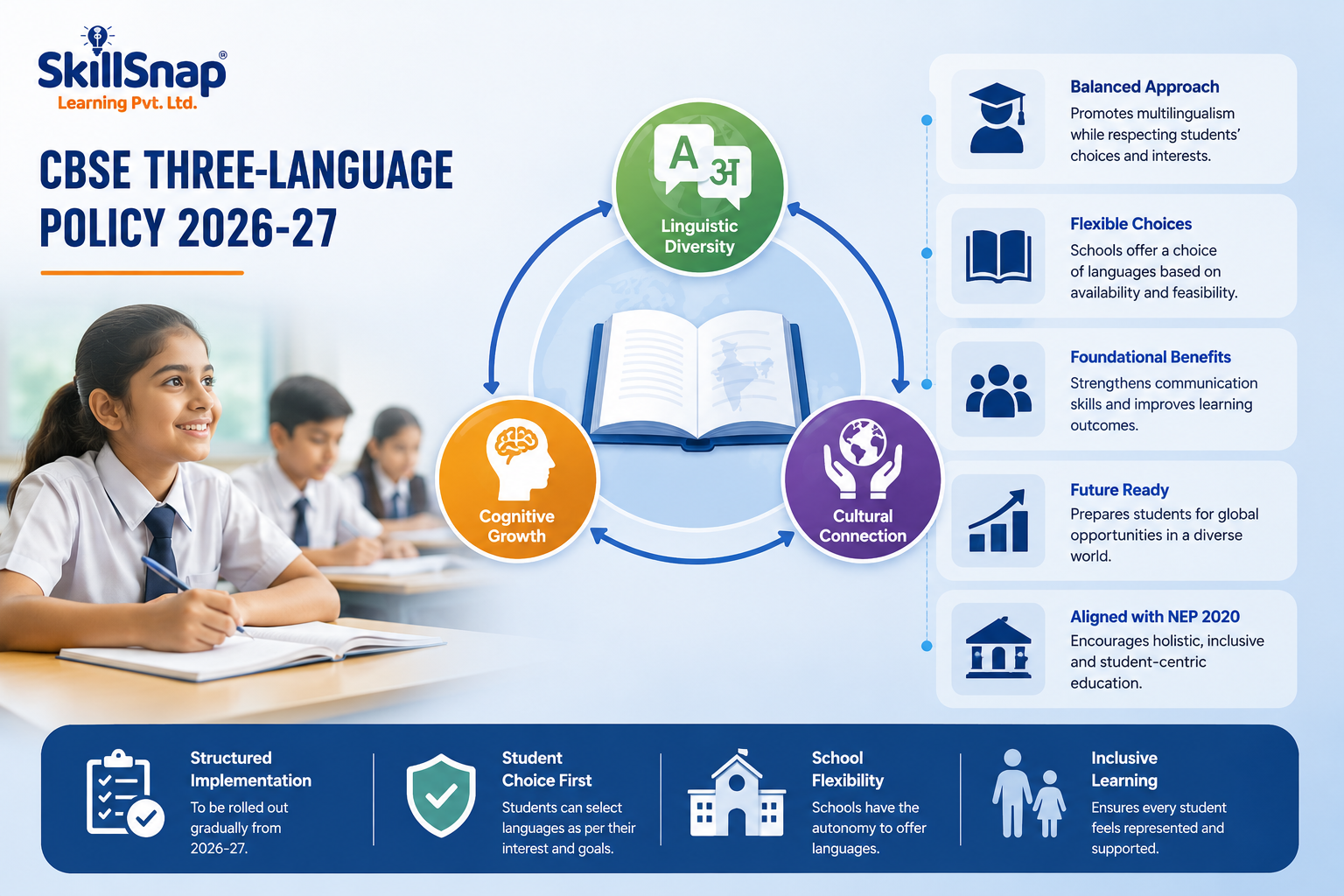
The CBSE board has updated its guidelines for the CBSE three-language policy from the Academic Session 2026-27 onwards. This three-language policy is a step taken by CBSE to align itself with NEP 2020, which states that the students should study three languages and, out of these three languages, at least two are to be Indian native languages.
In case you're a parent or a teacher, or even a student looking to understand how the new language policy of CBSE impacts your classroom, here is everything you need to know about the same.
What Is the CBSE Three-Language Policy?
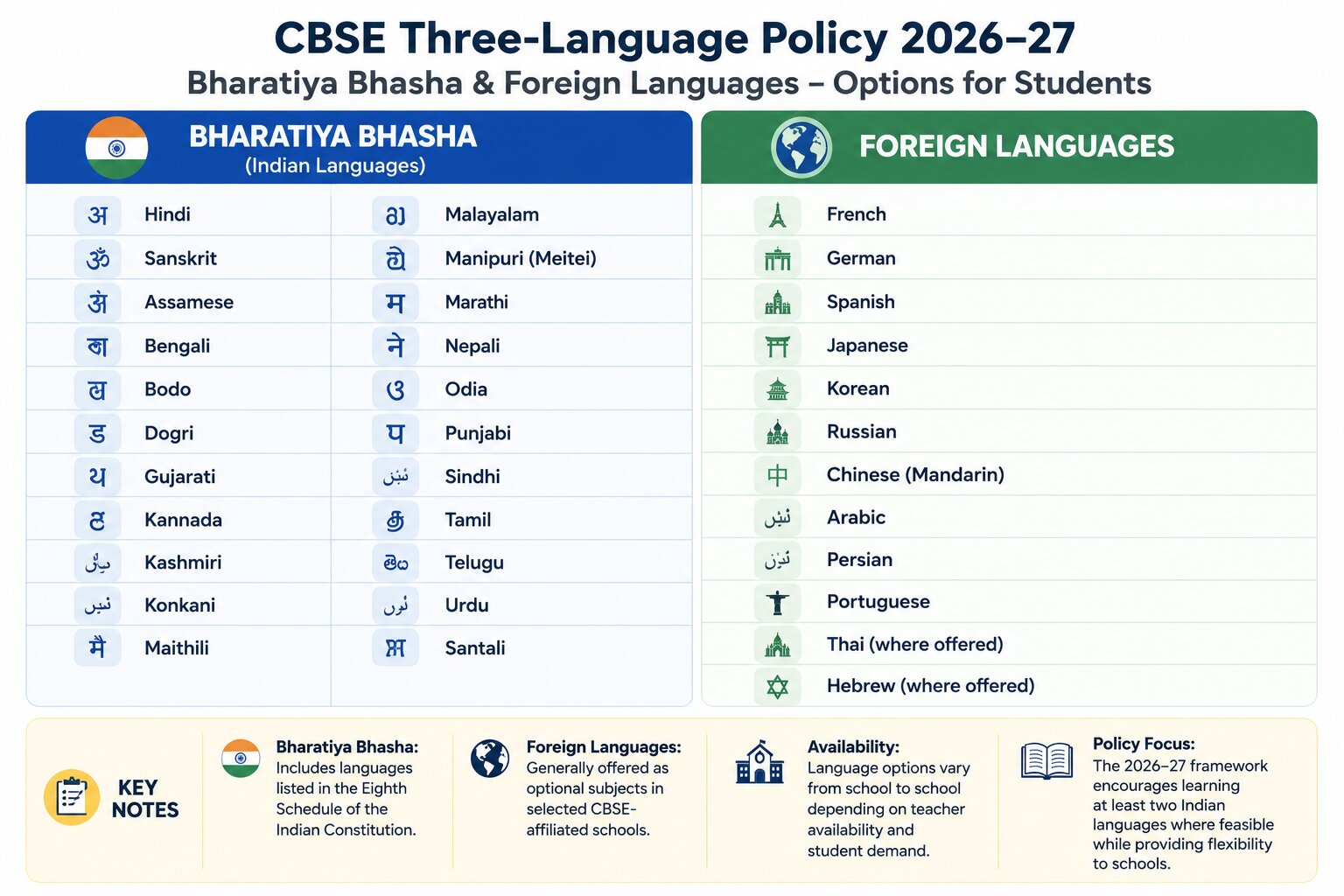
In accordance with the provisions of the NEP 2020 scheme, all CBSE schools need to make sure that their students take up studies in three languages; among which two languages should necessarily be Bhartiya Bhashas (Indian native languages like Hindi, Tamil, Telugu, Marathi, Bengali, Punjabi, Gujarati, Odia, Assamese, Kannada, Malayalam, Sanskrit, etc.) while the third language, which is called R3, may be either a Bhartiya Bhasha or a foreign language like English, French, German, Spanish, Arabic, etc. This new policy has been introduced by CBSE in a phased manner.
Key Highlights of the CBSE Language Policy
The Class X batch of 2026-27 would not be implementing the revised policy on languages.
Students in Classes VII, VIII, and IX would not be appearing in the board exam for their third language despite moving up to Class X.
However, students in Classes VII, VIII, and IX, who were already taking two foreign languages, would continue doing so and should compulsorily study one Bhartiya Bhasha now.
Learning materials for all classes would be made available by CBSE and NCERT within a specified time period.
This would make language learning a purposeful, interesting, and joyous process rather than an exam-oriented one.
Class-Wise Breakdown of the CBSE Three-Language Rule
Class X (2026–27): No Change
Students currently in Class X will continue with the old two-language system. No third language is required for this batch.
Class IX (2026–27): Transition Year
All Class IX students need to study three languages, out of which at least two should be Bhartiya Bhashas. The CBSE has identified three possible situations:
Learning two Bhartiya Bhashas already (such as Hindi and Tamil): You can choose another Bhartiya Bhasha or even a foreign language such as English or French as R3.
Learning one Bhartiya Bhasha and one foreign language (such as Tamil and English): It is mandatory to choose any Bhartiya Bhasha as your third language.
Learning two foreign languages (such as English and French): As an exception, you can carry on with both, but you have to include one Bhartiya Bhasha as your R3.
Note: It is important to note that the third language for Class IX students will be evaluated based on school-based assessment alone; no CBSE board examination will be conducted for R3 once these students reach Class X in 2027–28.
Class VII and VIII (2026–27)
These students will keep learning three languages in Classes IX and X, two of which will be Bhartiya Bhashas. The ones who have already begun to learn two foreign languages should learn one Bhartiya Bhasha along with the two and keep on learning it till Class X. Like Class IX, the evaluation of R3 for these batches is internal.
Class VI (2026–27 and Onward)
This is the first batch that is aligned with the new policy in its entirety. Two out of three languages have to be Bhartiya Bhashas, and once this batch finishes Class X, they will appear for the board exam in R3. NCERT will publish R3 textbooks for 22 scheduled Bharatiya Bhashas.
Exemptions Under the CBSE Three-Language Policy
CBSE has made several exemptions for students in the following cases:
Children With Special Needs (CwSN): Exemptions as per the Rights of Persons with Disabilities (RPwD) Act, 2016.
Schools not in India: Complete exemption from learning an indigenous Indian language as R3.
Foreign nationals coming back to India: Exemption from learning an indigenous Indian language as R3.
Families moving abroad: The students are allowed to study the same language pairings as before if the parents/guardians move to a different state.
How Will Schools Manage Teacher Availability?
CBSE has adopted flexible staffing options to assist the schools in implementing this policy effectively. The schools may:
Utilise the existing staff members who have functional proficiency in the language.
Hire the retired teachers/post graduates.
Utilise Sahodaya clusters for inter-school sharing of resources.
Follow the virtual/hybrid mode of teaching.
Why This Policy Matters
CBSE has ensured that students will not be at a disadvantage due to this shift. The objective of this policy is concept clarity and happy learning, and not rote learning or exam pressure. Multilingualism will not only enhance cultural grounding but also accommodate foreign language speakers.
Conclusion
CBSE’s three-language policy from 2026-27 is a gradual implementation of the language vision of NEP 2020. Whether you are in class VI or X, CBSE has ensured that relaxations and other facilities have been provided to make sure the change does not feel like a disruption but an easy adaptation for all of you. The message needs to be conveyed in a positive way to all CBSE Students.
Check out the Latest CBSE Syllabus for 2026-27 and download free study resources from SkillSnap Learning. We provide free study resources for students in Classes 6 to 12, including NCERT Solutions, Notes, Assignments, Sample Papers, Previous Year Question Papers, and Syllabus.